
Things to Do in Baku in April
April weather, activities, events & insider tips
Low Season · Budget Friendly
April Weather in Baku
Long-run averages for April
62°F (16°C)
High Temp
48°F (8°C)
Low Temp
0.7 inches (18 mm)
Rainfall
72%
Humidity
6
Sunny-Day UV
⚠ The Khazri north wind is a genuine hazard. It hits exposed sections of Baku Boulevard and the Absheron Peninsula. Gusts are strong enough to destabilise lightweight travelers. They blow belongings off cafe tables. Coastal walking becomes uncomfortable. The wind is not seasonal. Baku earns its historical name as the City of Winds year-round. April is among the windier months. Plan outdoor activities for mid-morning. Winds tend to be lightest then. Avoid the exposed waterfront during strong gusts.
⚠ Dust carried by the Khazri from the dry Absheron steppe can irritate eyes and airways. This happens on windy days. Contact lens wearers should carry saline drops. Travelers with respiratory sensitivities should too. Consider a light face covering for excursions to Gobustan and the mud volcanoes. There is no wind shelter there.
Making the most of April in Baku? Browse tours and activities in Baku on GetYourGuide.
Is April Right for You?
Weigh the advantages and considerations before booking
Advantages
- + April hits a sweet spot between Baku's raw winter and the Caspian summer heat. Daytime temperatures hover around 16°C (62°F), warm enough to spend hours walking the Old City's limestone alleys without overheating, cool enough that the city smells like stone and salt air rather than exhaust. The light has a particular clarity this month. Low-angle sun bouncing off the honey-colored walls of Icherisheher turns the whole medieval quarter into something a photographer would stage but couldn't.
- + Rainfall is negligible in April. Roughly 18 mm (0.7 inches) for the entire month makes Baku one of the driest capital cities in Europe and Central Asia during spring. Plan outdoor excursions to Gobustan or the Absheron Peninsula without much worry about cancellations. The desert-steppe landscape south of the city takes on a brief green flush that disappears by June.
- + Shoulder season means the major sites breathe. The Maiden Tower, the Palace of the Shirvanshahs, the Heydar Aliyev Center. In July and August these fill with Gulf tourists escaping Arabian summer. April gives you room to stand in the Shirvanshahs' courtyard and hear the pigeons rather than other visitors. Lines at the Flame Towers viewing terrace thin out enough that you can linger at dusk without being shuffled along.
- + Accommodation pricing dips noticeably from summer peaks. April falls before the Formula One buzz and the Caspian beach season, so you are likely to find better rates and wider availability across most of Baku's hotel stock. Booking two to three weeks ahead is usually sufficient. Summer dates in the waterfront district can fill a month or more out.
Considerations
- − Baku's wind is not a footnote. It is a defining feature of the city, and April is one of the windier months. The Khazri, a cold north wind that funnels down the Absheron Peninsula from the Caspian, can gust hard enough to knock a cafe umbrella sideways and turn a pleasant 16°C (62°F) afternoon into something that feels closer to 8°C (46°F). Locals barely flinch. First-time visitors consistently underestimate how quickly the wind changes the equation. It does not rain you out. It blows you out.
- − The Caspian Sea is still far too cold for swimming in April. Water temperatures sit around 10-12°C (50-54°F), which means the beach clubs along Shikhov and Bilgah are largely shuttered or operating as restaurants only. If a Caspian swim is part of your plan, you need June at the earliest.
- − Evenings drop toward 8°C (46°F), and the combination of wind and cooling temperatures after sunset means outdoor dining on Nizami Street or along Baku Boulevard requires a proper jacket, not just a shirt. The transition from comfortable afternoon to chilly evening catches visitors off guard. This happens to those arriving from warmer climates who packed for a single temperature.
Settled on April? Compare hotel prices in Baku for your dates on Trip.com.
Best Activities in April
Top things to do during your visit
April strips away Baku's winter edge. The Caspian wind still carries a salt-laced chill in the mornings. By midday the air settles into dry warmth around 16 degrees Celsius. Comfortable enough for long seafront walks without the sweat-soaked exhaustion of a Caucasus summer. Rainfall is minimal, averaging just 18 millimeters for the entire month. Overcast days pass with little more than brief drizzle. Pack a light jacket for evenings when temperatures dip to around 8 degrees. Leave the umbrella as an afterthought. This is one of the driest stretches in Baku's calendar, matched only by May. The low humidity makes the city's limestone and sandstone architecture glow pale amber under afternoon sun rather than the grey it takes on in damp autumn months. The city's rhythm in April sits between seasons. Summer tourists haven't arrived. The winter quiet has lifted. Locals reclaim the Baku Boulevard promenade in early evenings, families strolling past the Carpet Museum while the Flame Towers overhead shift through LED color cycles against a sky still holding pink light at half past seven. The Old City, Icherisheher, feels unhurried. Tea houses along narrow stone lanes fill with clatter of tulip-shaped arman glasses on saucers and low hum of backgammon dice. Street vendors near the Maiden Tower sell roasted chestnuts whose smoky sweetness drifts through alleys, mingling with sharper scent of fresh herbs bundled on sidewalk tables outside the Teze Bazaar. April is when Baku belongs to the people who live there. A visitor who pays attention will feel the difference. Safety in Baku is straightforward. The city consistently ranks among the safest capitals in the region. Solo travelers, including women, navigate it without unusual precaution. Petty crime exists at the level you would expect in any city of two million. Violent crime directed at visitors is exceptionally rare. The metro is clean, well-signed, and cheap. Taxis should use a meter or be negotiated before departure. The purple London-style cabs are a reliable choice. Nightlife centers on Nizami Street and the cluster of rooftop bars near Fountain Square, where the cocktail scene has sharpened considerably in recent years. The city sleeps earlier than Istanbul or Tbilisi. For dining, Baku rewards the curious. Beyond the kebab houses, look for restaurants serving shah plov, saffron rice sealed in a golden pastry dome that shatters under a spoon, releasing steam fragrant with dried apricots and chestnuts. The beach season hasn't started in April. The Caspian water temperature sits well below comfortable swimming range. The shoreline parks are good for running or cycling in cool morning air.

Baku Downtown Original Walking Tour
walking_tourThe Baku Downtown Original Walking Tour covers the medieval core of Icherisheher on foot, threading through gates and lanes that have channeled foot traffic since the twelfth century. Your guide leads past the Maiden Tower's stolid basalt cylinder, through carved stone corridors of the Palace of the Shirvanshahs where pigeons roost in empty window arches, and into residential quarters where laundry lines cross overhead and cats stretch on warm doorsteps. The route surfaces details that a solo walk misses. The hamam whose domed roof still vents steam. The caravanserai courtyard now converted to a carpet shop where the wool smells of lanolin and dye. The precise spot where the city walls were breached during the Russian siege.
A guided walk that turns Baku's Old City from a photogenic backdrop into a legible story, connecting its Zoroastrian roots, medieval trading wealth, and Soviet-era scars in a single coherent thread.
Insider tip: Request a morning start before ten. The narrow lanes of Icherisheher stay in shade and the stones underfoot are cool. You'll beat the tour bus groups that arrive from cruise ships after eleven.

Baku City Tour with Local Guide-Old City, Flame Towers, Boulevard
guided_experienceThe Baku City Tour with Local Guide pairs the medieval compressed density of the Old City with the glass-and-steel exhibitionism of modern Baku in a single sweep. You start among the sandstone alleys of Icherisheher, where the air smells faintly of damp stone and cumin from nearby kitchens, then move to the Boulevard seafront where the Caspian stretches flat and silver to the horizon. The Flame Towers loom above every sightline. Three tapering glass skyscrapers whose surfaces catch and throw light differently with every passing cloud, and whose nighttime LED display turns them into pillars of shifting fire visible from thirty kilometers away. A local guide contextualizes what no guidebook can. Which Soviet-era buildings were repurposed. Which neighborhoods gentrified in the oil boom years. Where to eat after the tour ends.
The most efficient way to grasp Baku's jarring architectural range, from a walled city that predates the Crusades to a skyline that could be mistaken for Dubai, with someone who can explain why both exist in the same place.
Insider tip: Ask your guide to include a stop at the Heydar Aliyev Center if the route allows it. Even from the outside, the building's fluid white curves designed by Zaha Hadid are worth seeing. The surrounding park has some of Baku's best benches for people-watching.

Baku: Old & Modern City Tour, Wine Tasting & Funicular Ride
foodThe Old and Modern City Tour with Wine Tasting and Funicular Ride adds two sensory dimensions that a standard city tour omits. The funicular climbs from the seafront to Highland Park. As the cabin rises the entire crescent of Baku Bay opens beneath you. The dark stone of the Old City walls. The white lattice of the Crystal Hall. Container ships inching across the Caspian. The metallic hum of the cable vibrates faintly through the handrail. At the top, the wind picks up and carries the mineral tang of the sea mixed with dry grass of the hillside. The wine tasting introduces Azerbaijani varietals that most visitors have never encountered. Madrasa grapes grown in the Shamakhi foothills, producing reds that taste of black cherry, iron, and sun-baked earth. This is not Georgian wine country. The contrast matters. Azerbaijani winemaking is smaller, less known, and finding its own voice.
Combines the city's best aerial perspective with a genuine introduction to a wine tradition that most travelers do not know exists, anchoring both in Baku's geography and terroir.
Insider tip: Ride the funicular at sunset. The Flame Towers ignite their LED sequences just as the sky darkens. You descend through a city that has visibly transformed in the twenty minutes since you went up.

Private Tour to Gobustan Mud Volcanoes and Absheron.
private_tourThe Private Tour to Gobustan Mud Volcanoes and Absheron Peninsula pulls you out of Baku's polished center and into a landscape that feels extraterrestrial. Gobustan's mud volcanoes, over three hundred of them concentrated on a dusty plateau south of the city, are low cones of grey clay that bubble and belch with a thick, wet gurgling sound, spitting cold mud that smells faintly of sulfur and petroleum. The ground around them is slick and pale, cracked into geometric tiles by evaporation. Azerbaijan holds roughly half of the world's mud volcanoes. Gobustan is the densest cluster. Nearby, the Gobustan Rock Art reserve preserves petroglyphs scratched into sandstone by Mesolithic hunters. Images of reed boats, dancing figures, and aurochs that predate Sumerian writing. The Absheron leg adds the Ateshgah Fire Temple, a Zoroastrian and Hindu sanctuary where natural gas still feeds flames that lick from the stone floor, and Yanar Dag, a hillside that has burned continuously for decades, its orange flames flickering even in daylight against the pale rock face.
A single day that covers forty thousand years of human presence in Azerbaijan, from Paleolithic hunters to Zoroastrian fire-worshippers, set against a geological landscape found almost nowhere else on Earth.
Insider tip: Wear shoes you do not mind getting muddy. The path to the active volcanoes is unpaved and the clay sticks to everything. Bring wet wipes for your hands afterward. The mud dries to a powdery grey film.

Day Trip: Gobustan Mud Volcanoes, Fire Temple, Burning mountain
day_tripThe Day Trip to Gobustan Mud Volcanoes, Fire Temple, and Burning Mountain covers similar ground to the private tour but in a group format, which changes the experience in useful ways. You share a vehicle and a guide. More conversation. More questions from travelers with different reference points. A pace set by collective curiosity rather than a single itinerary. At Yanar Dag, the burning mountainside on the Absheron Peninsula, the group tends to linger. For good reason. Even in April's mild afternoon light, the natural gas flames dancing along a ten-meter stretch of exposed rock produce a heat you can feel on your face from several paces away. The air carries a faint petrochemical warmth that mixes with the cool Caspian breeze rolling in from behind. The Ateshgah Fire Temple, a few kilometers away, is quieter. A courtyard of cells where Zoroastrian and later Hindu worshippers tended eternal flames. The stone walls still hold the soot stains of centuries.
The most accessible way to witness Azerbaijan's geological peculiarity, a country built on fire, without the cost of a private vehicle, and with a guide who contextualizes the Zoroastrian heritage that shaped the nation's identity.
Insider tip: Sit on the left side of the vehicle heading to Gobustan for the best views of the Caspian coastline during the drive. Bring a windbreaker. The mud volcano plateau is exposed and the April wind across the open steppe can feel sharper than it does in the city.
This month: April's dry conditions and mild temperatures make the unpaved paths at the Gobustan mud volcano site more navigable than during the wetter autumn months, when the clay turns slippery.

Private Transfer from Baku Airport to Azerbaijan.
transportThe Private Transfer from Baku Airport to the city eliminates the one friction point that greets every arriving traveler: the twenty-five-kilometer corridor between Heydar Aliyev International Airport and central Baku. The driver meets you at arrivals, handles luggage, and delivers you to your hotel or apartment without the negotiation that taxi queues sometimes require. useful on late-night flights when the airport express bus has stopped running. The ride itself is an involuntary introduction to Baku. The highway passes through industrial outskirts where oil derricks still nod rhythmically against the skyline, then swings along the Caspian shore where the water glints under refinery lights or morning sun depending on your arrival time, before the Flame Towers appear ahead, signaling the city center.
A fixed-cost, no-haggle airport transfer that removes arrival stress and puts you in central Baku in under thirty minutes, with a driver who knows which hotel entrances to use and which roads to avoid during rush hour.
Insider tip: Share your flight number when booking so the driver can track arrival delays without you needing mobile data upon landing. Confirm whether your accommodation is inside the Old City walls. Vehicle access there is restricted and the driver will need to drop you at the nearest gate.
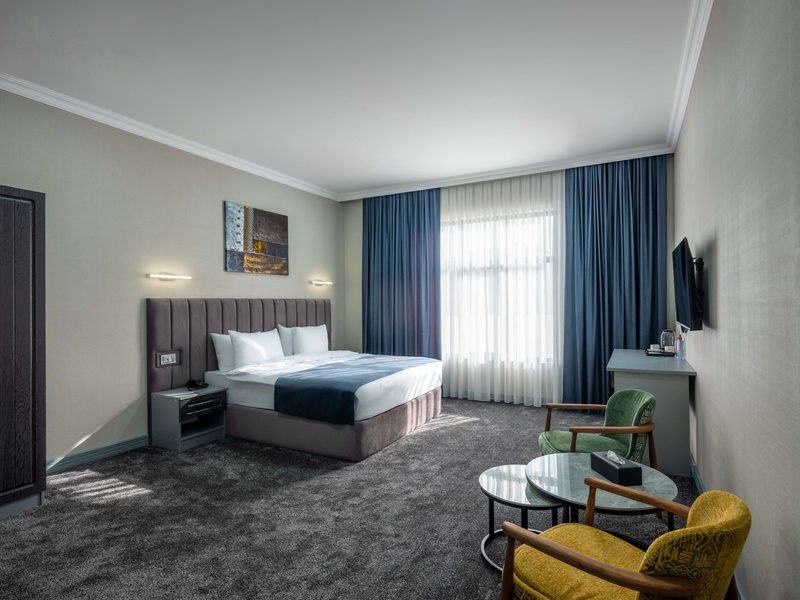
Where to Stay in Baku in April
Hand-picked hotels across price tiers for April travellers.
Packing Checklist
Bookmark this page — your progress is saved between visits
Need the full list with shopping links?
Climate-specific gear, brand recommendations, and what to leave at home.
View Baku Packing List →Essential Tips
Insider knowledge and common pitfalls to avoid
Insider Knowledge
Baku's tea culture is not a tourist attraction. It is how the city operates. The tulip-shaped armudu glass holds strong black tea. It comes with a saucer of cherry jam and a cube of hard sugar. Hold the sugar between your teeth while sipping. Every shop, carpet showroom, and taxi dispatcher's office offers this. Accept it. Actual conversations happen here. Shopkeepers drop their sales pitch and talk about the neighbourhood. You start to feel the rhythm of a city that runs on caffeine and hospitality rather than efficiency. The tea gardens along the seafront south of the Old City walls are where Bakuvians go after work. They reopen in April after winter closures. Fresh samovar setups appear. The same plastic chairs they have used for decades remain.
The metro system is Soviet-era, deep-bore, and strikingly ornate. Marble columns, chandeliers, mosaic murals depicting everything from Azerbaijani folklore to the conquest of space. It is also one of the cheapest and fastest ways to cross the city. Tourists overlook it. They default to taxis instead. The stations at Nizami and Icherisheher are worth visiting as architecture. Go even without a destination. Trains run frequently. The system is clean and safe, including late evening.
Baku is overwhelmingly safe for tourists. Solo women travelers included, at any hour in the central districts. Violent crime against visitors is extremely rare. The city center is well-lit and policed. The genuine risks are mundane. Aggressive taxi drivers quote inflated prices from the airport. Use the official taxi stand or a ride-hailing app. Pickpockets work Fountain Square on busy evenings. The wind is a bigger daily hazard than crime. It can knock you off balance on exposed stretches of the boulevard.
Baku's food scene rewards the curious. It punishes the passive. Restaurants along Nizami Street display English-language menus on easels outside. They serve competent but unremarkable versions of Azerbaijani classics at marked-up prices. Walk two blocks in any direction. You will find neighbourhood spots where the plov arrives in a copper pot heavy enough to anchor a boat. The saffron-stained rice pilaf is layered with dried fruits, chestnuts, and slow-cooked lamb. The smoky tang of charcoal-grilled kebab reaches you from the kitchen doorway before you sit down. Look for places where bread is baked in a tandir oven on premises. You can hear the slap of the dough against the clay walls. You can smell the yeasty char from the street. Qutab are best eaten seconds off the saj griddle. The thin stuffed flatbreads filled with minced lamb or fresh herbs crackle under your fingers.
Avoid These Mistakes
Packing for a Mediterranean spring is a mistake. Arriving unprepared for the wind is worse. Baku's temperature readings are misleading. They do not account for the Khazri. It strips perceived warmth by 5-8°C (9-14°F) on exposed stretches. Every April, visitors in light jackets cluster miserably on the boulevard. Locals walk past in proper coats. Dress for the wind chill, not the thermometer.
Assuming the Caspian coast means beach weather is wrong. In April, the water is cold enough to shock. The beach infrastructure is shuttered. Visitors who build their itinerary around waterfront leisure end up with dead time. Treat April's Baku as a walking, eating, and culture city. It is not a coastal one. The beach season starts in late June at the earliest. Even then the Caspian is not the Aegean.
Skipping the day trips outside Baku is a mistake. The city itself is compelling for two to three days. Travelers who spend a full week within city limits miss the point. Gobustan's petroglyphs, the Absheron fire sites, and Sheki in the mountains offer a dimension of Azerbaijan. Ancient, geological, rural. Baku's glass-and-steel waterfront deliberately obscures this. The country beyond the capital is where the trip deepens.
Short on time? See day trips around Baku on GetYourGuide.
Ready to plan your trip to Baku?
Now that you've got the research covered, here's where to go next.
Explore More Activities in Baku
Didn't see anything interesting yet?
Browse Viator's full catalog of tours, day trips, food experiences, and private guides in Baku.
See All Baku Tours on Viator